Throughout human history, the idea of creating thinking machines has been a deep-rooted passion, extending from mythologies to modern science. Artificial intelligence (AI), which is integrated into every aspect of our lives today, did not appear overnight. Behind it lies an exciting adventure that includes mathematical theories, philosophical debates, great disappointments ("artificial intelligence winters") and tremendous technological leaps.
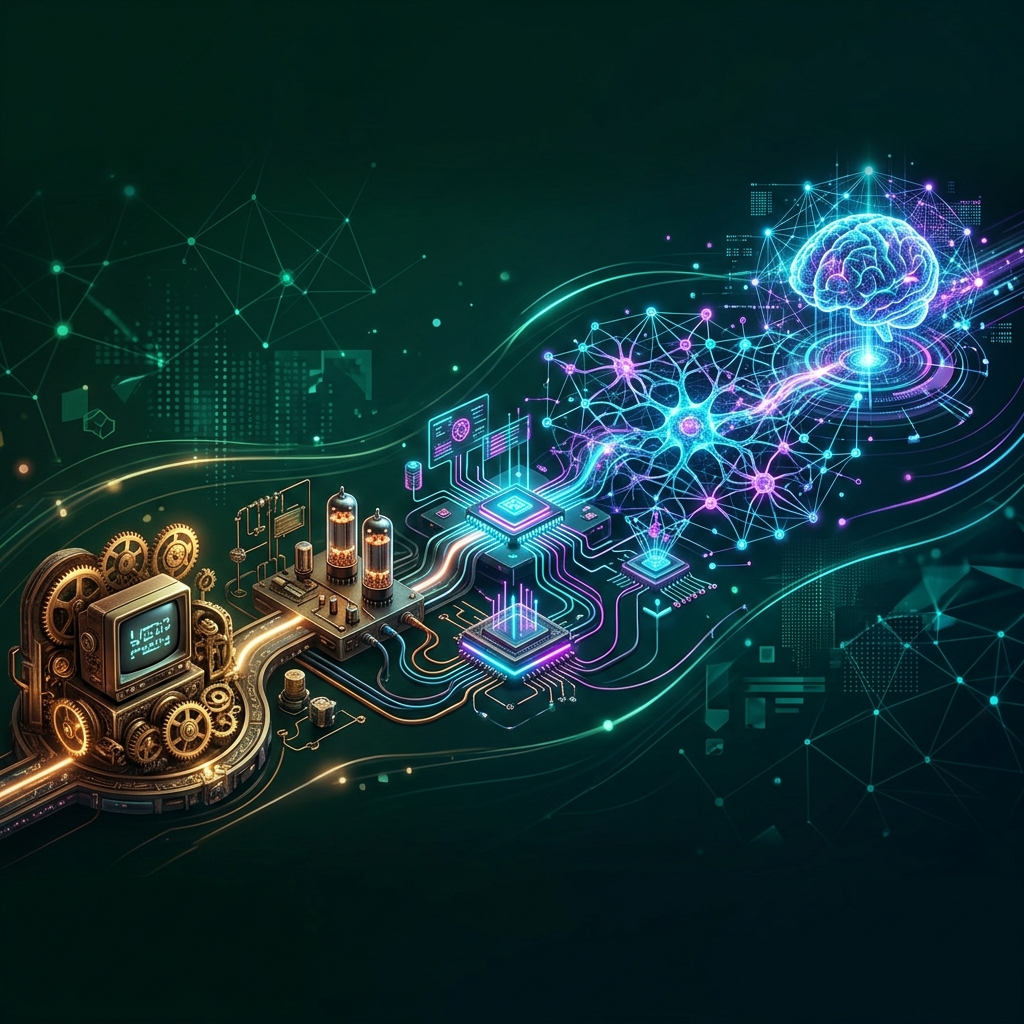
1. The Beginning of the Journey: Turing and the First Seeds (1940-1950)
Alan Turing, who is considered the father of modern artificial intelligence, asked a historical question in his article "Computing Machinery and Intelligence" published in 1950: "Can machines think?" Turing is famous for testing whether a machine can imitate a human in its linguistic interaction with a human. He proposed the "Turing Test". This period is the period when the philosophical and theoretical infrastructure of artificial intelligence was established.
2. Birth of the Term: Dartmouth Conference (1956)
In 1956, visionary scientists such as John McCarthy, Marvin Minsky, Nathaniel Rochester and Claude Shannon came together at Dartmouth College. At this historic meeting, the term "Artificial Intelligence" was used officially for the first time. Participants sparked a wave of optimism by arguing that even the smallest features of human intelligence could be simulated by a machine.
3. The First Golden Age and Disappointments: The Winters of Artificial Intelligence (1970-1990)
The rapid successes of the 1950s and 60s (the first checkers-playing programs, simple language translators) gave way to the realization of limits in the 1970s. The projects could not achieve the targeted success due to insufficient computing power and lack of data. With the funding cuts, periods of stagnation called the "Artificial Intelligence Winter" occurred. Although these winters were briefly broken by the "Expert Systems" wave in the 1980s, technological constraints were not overcome until the early 90s.
4. Rise of the Machines: Deep Blue and the Data Age (1997-2010)
In 1997, IBM's supercomputer Deep Blue defeated world chess champion Garry Kasparov, marking one of the biggest turning points in the history of artificial intelligence. This victory was an achievement of high computing power and brute force algorithms rather than symbolic artificial intelligence. With the spread of the Internet, the exponential increase in the amount of data began to feed machine learning algorithms.
5. Hardware Revolution: Transitioning from the CPU to the GPU Era (2012-2017)
The overwhelming success of deep artificial neural networks (Deep Learning) in the ImageNet visual recognition competition in 2012 sparked the modern AI revolution. The real hero behind this revolution was the **GPU (Graphics Processor)** hardware that replaced processors (CPU). The parallel processing power of multi-core GPUs has made it possible to train massive artificial neural networks. The **GAN** (Adversarial Generative Networks) architecture developed by Ian Goodfellow in 2014 laid the first foundation of content production by launching the ability of artificial intelligence to "produce realistic imitations and fake images".
6. Transformer Architecture and the Generative AI Explosion (2017-2022)
The famous article *"Attention Is All You Need"* published by Google researchers in 2017 introduced the **Transformer** structure, the architect of today's revolution in artificial intelligence. This groundbreaking architecture for analyzing sequence data (e.g. sentences) gave rise to OpenAI's GPT (Generative Pre-trained Transformer) models. **GPT-3**, which reached 175 billion parameters in 2020, shocked the industry by writing human-like texts. In 2021, the first models that can produce images from text were introduced to the public with **DALL-E**.
7. Multimedia (Multimodal) Creativity and the Age of Sora, Suno, Blackwell (2022-Present)
With the launch of ChatGPT in November 2022, artificial intelligence has ceased to be just an engineering subject and has become an everyday tool of the masses. In 2023, the models rose to the **Multimodal** (GPT-4, Gemini) level, which processes not only text but also audio and visuals at the same time.
In 2024, the limits of creativity were completely lifted: While services such as **Suno** and **Udio** produced studio quality music and songs from text descriptions, OpenAI's **Sora** model began to produce cinematic quality videos that perfectly comply with the laws of physics. Underneath this enormous software load was the huge leap forward in the hardware world: NVIDIA's **Blackwell** architecture and FP4 processing power completely eliminated the hardware bottleneck, offering performance increases of up to 30 times in energy efficiency and parallel computing speed compared to the previous generation.
Today (2025-2026), **AI Agents** that can make autonomous decisions and write code, navigate the web and complete complex tasks. We are at the center of our era.
Interactive Timeline SectionAI Timeline (Historical Milestones)
Alan Turing and "Can Machines Think?"
Alan Turing laid the theoretical and philosophical foundations of artificial intelligence by proposing the famous Turing Test. Isaac Asimov published the book "I, Robot".
Dartmouth Conference
John McCarthy and his team officially introduced the term "Artificial Intelligence" into the literature for the first time.
The First AI Winter
With the lack of computing power and funding cuts, artificial intelligence studies experienced the first major recession.
Deep Blue Victory
IBM's supercomputer Deep Blue proved the power of brute force algorithms by beating world chess champion Garry Kasparov.
The Age of GPU and Deep Learning
AlexNet's ImageNet success has put deep learning on the rise, ushering in the transition from CPUs to multi-core GPU processing power.
Transformer Revolution
With Google's "Attention Is All You Need" article, the Transformer architecture was born and the foundation of large language models was established.
GPT-3 and DALL-E Era
GPT-3, a language model with 175 billion parameters, and DALL-E models, which took the first step from text to visual, were introduced.
ChatGPT and Meeting the Masses with AI
With the launch of ChatGPT, generative artificial intelligence (Generative AI) has spread all over the world. Midjourney peaked in painting production.
The Age of Sora, Suno and Blackwell
Creativity and hardware boundaries have been exceeded with Sora, which produces video from text, Suno, which produces songs, and NVIDIA's Blackwell super GPU chips.
Artificial Intelligence Agents
The era has begun in which autonomous agents that independently plan and code individual tasks and can perform transactions on the web are integrated into business life.
Conclusion: On the Threshold of the Future
This adventure, which started as a small academic study at Dartmouth, has today become the most powerful transformative force shaping the future of humanity. As artificial intelligence evolves from yesterday's philosophical dream to today's living technology, it continues to move at an exciting pace towards tomorrow's superintelligence (AGI) goals.
Comments (0)
Leave a Comment